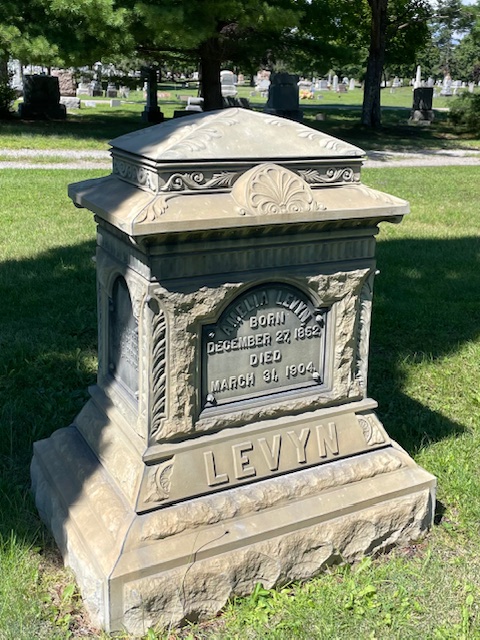
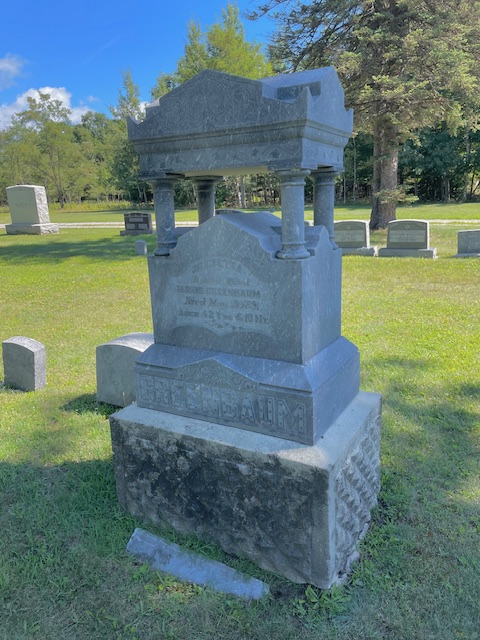
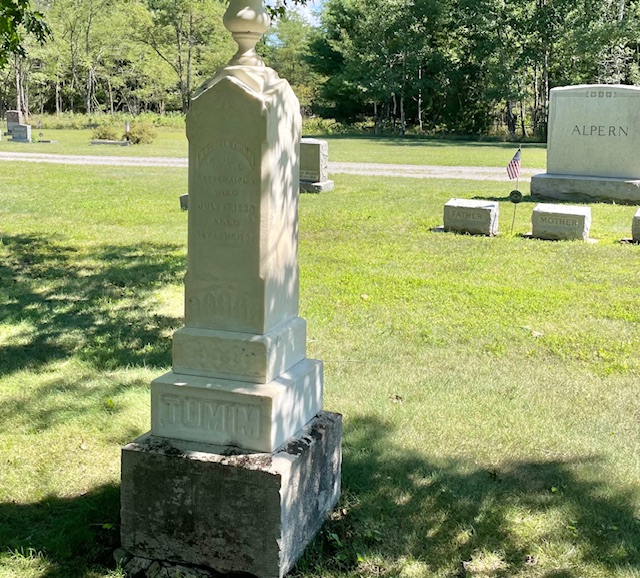
Honoring those who pass before us is an important part of Jewish tradition, thus Temple Beth-El maintains the Hebrew Benevolent Society Cemetery located off Washington Avenue in Alpena. TBE Members Dr. Gregg Resnick and Mary Swartzendruber work closely with the City of Alpena Sexton Tim Corn to help families, Jewish as well as Jewish families with non-Jewish members, who wish to bury their loved ones in the Hebrew Benevolent Society Cemetery. Mary has made it her mission to maintain the grounds and the headstones as well as update the history and plot assignments; her devotion is immeasurable. For further information, please contact Mary at Swartzrivkah@gmail.com.
As of August 2025, there are more than 135 graves in the cemetery. Of those more than 135 graves, 13 are the graves of veterans, including a Confederate soldier and a female veteran. Most of the graves are the final resting places for those from Alpena and surrounding towns as well. Our Hebrew Benevolent Society Cemetery has and will continue to serve much more than the Alpena area.
The importance of the Hebrew Benevolent Society Cemetery is evident in its history as recorded in the following excerpts from An American Shtetl, which was written by then-Student Rabbi Robert Leyman October 2, 1958.
Religious Life of Alpena’s First Jews: The beginnings of the first Jewish organization in town, the Hebrew Benevolent Society, may be traced through its minutes which commence with the entry of August 7, 1875. Here we are told that [there was] “an informal meeting held by the Hebrews of this place for purpose of Establishing a Benevolent Society and also procure means for buying a burial ground” (p. 11).
At a meeting held August 15, 1875 … It appears that by this time a burial site had already been chosen, for there is reference to a committee being appointed to inspect the work done on the cemetery. We can, therefore, assume that the cemetery was purchased in late August or early September 1875 (p. 12).
Pages 13-14 – The Hebrew Benevolent Society was thus formally instituted on April 1, 1877 with the adoption of a constitution and by-laws. These were amended and re-adopted in April 1896. Articles II and III of the amended by-laws state that every Hebrew residing in the city of Alpena, or its vicinity, may become a member. They go on to say: “This Society is formed for the purpose of procuring a suitable place for the burial of their dead, and to further the Jewish interests of this place” (pp. 13-14).
Although the Hebrew Benevolent Society was organized primarily to procure and maintain a cemetery, there is hardly any mention of it during the ten years following the establishment of the Society. We do find the following entry, however, in the minutes of November 6, 1887: “Moved and sec. to appoint a committee for the investigation on cemetery affairs, if it is any improvements necessary” …
Monuments in the cemetery indicate that, before 1900, at least nine people under the age of 25 were buried there. All told there are 61 graves in the cemetery including a mausoleum containing the crypts of Herman Joachimsthal, his wife Leah Rachel Cohen, and his brother Isidor. Only nine monuments have Hebrew epitaphs engraved in them; the rest have either no Hebrew markings at all or merely the name and the date of death in Hebrew (pp. 16-17).


 Temple Beth-El, Alpena